
Understanding Callahan County Releases
Release from the Callahan County Jail means that the Sheriff's Office ended its custody event. It does not always mean the person is free of all government custody. Someone may leave on bond, after receiving credit for time served, following dismissal or a court order, or after completing a local sentence. Another person may be transferred to the Texas Department of Criminal Justice, another county jail, a federal agency, or immigration custody. The final jail transaction and the receiving agency, when recorded, distinguish those outcomes.
The Sheriff-linked Kologik Local Arrest Report is a live custody view. A person normally drops from it when that jail event ends. The lasting proof is held by the office that created each part of the record: the Sheriff for booking and physical release, the court clerk for the bond order or disposition, and TDCJ for a later state-prison intake or discharge. Texas VINELink can report a custody change, but the alert does not replace the actual release entry.
Callahan County Release Types
The label attached to a release matters. Bond ends the jail's custody under a bond or court order, but it is not an acquittal. Time served means the custodial portion received enough credit; other terms of the judgment may remain. Dismissal describes a charge outcome and may not state the time the jail door actually opened. Parole and mandatory supervision are TDCJ release types, while probation, also called community supervision, comes from a court judgment.
| Event | What it means | Where to verify next |
|---|---|---|
| Bond or court release | County jail custody ends under filed authority. | Sheriff release entry plus the bond or court filing |
| Time served | Custodial time is credited or complete. | Release transaction and judgment |
| Dismissal | A charge or case was dismissed. | Clerk disposition plus jail timestamp |
| Transfer | The person left Callahan County Jail but may remain confined. | Receiving jail, TDCJ, BOP, ICE, or other named custodian |
| Parole or mandatory supervision | A conditional release from TDCJ custody. | TDCJ and the Parole Division |
| Probation | A court-ordered community supervision term. | Sentencing court and local supervision office |
Fields in Callahan Release Records
A focused Callahan County release record connects the completed custody event to the correct booking. Not every field is created, kept together, or public. Asking for specific items helps the Sheriff find the right transaction and makes a transfer easier to distinguish from a community release. A useful production may include these fields.
| Field | What it can establish |
|---|---|
| Full name and booking identifier | Which arrest and jail stay the entry concerns |
| Arrest and booking date/time | When Callahan custody began |
| Arresting agency and charges | The agency and allegations recorded at booking |
| Bond and cause number | A route to the filed court authority |
| Actual release date/time | When the Sheriff's physical custody event ended |
| Release type and authority | The recorded reason and authorizing source |
| Destination or receiving agency | Whether the person entered another custodian's control |
| Detainer notation | A public hold entry, if one exists and is disclosable |
A booking image, property acknowledgment, or other item can be requested when it serves a specific records or legal need. The custodian may redact protected facts or state that an item was not created. A roster printout is not a substitute for the final transaction because it describes present housing, not the way that housing ended.
Request Callahan County Release Records
Callahan County does not publish a sheriff-specific request portal, fee sheet, records-office schedule, or retention period. Send a narrow written request to the Sheriff's Office under the Texas Public Information Act. The Act applies to existing responsive records; it does not require the jail to create a new list or answer a general question.
- Identify the person with full name, booking date range, and any known arresting agency, charge, or cause number.
- Ask for the booking sheet and final release or disposition entry, including actual time, type, authority, and receiving agency.
- Request an electronic copy and a cost estimate before charges exceed a limit you choose.
- Ask the Sheriff to identify the legal exception for any withheld portion.
- Keep the request, response, estimate, and production date as part of the verification record.
432 Market Street
Baird, TX 79504
Phone: 325-854-1444, 24-hour non-emergency
Fax: 325-854-5998
The Texas Attorney General's request guidance says to describe the records clearly and use the governmental body's designated delivery method. An agency that seeks to withhold material generally must request an Attorney General decision within ten business days when no prior determination applies. That deadline is not a promise that records will arrive in ten days. State cost rules govern allowable charges because Callahan has not posted a local price.
Limits on Callahan Release Records
Government Code chapter 552 states the general access rule and contains exceptions. Section 552.108 can protect some law-enforcement material, while section 552.101 incorporates confidentiality from other law. Juvenile information, protected identifiers, victim information, medical material, and an expunged or sealed record can receive different treatment. Court files also follow judicial access rules and clerk procedures. Public display on a current roster does not make every related file public forever.
Texas expunction now appears in Code of Criminal Procedure chapter 55A. Nondisclosure is addressed in Government Code chapter 411. Each order has its own scope. A correction to a Kologik booking or release field should go to the Sheriff, the originating custodian. A wrong docket entry belongs with the clerk that maintains the case.
Do Callahan Bonds Prove Release?
Callahan's Kologik cards can show a bond amount for each charge and, in some cases, warrant information. That amount is not proof that anyone posted the bond. It also does not show that staff completed the release process. A person can have more than one charge, another hold, or a court condition that changes the outcome.
Pair the roster change with the Sheriff's actual release entry and the bond filing or order in the correct court. The release transaction supplies the physical time. The court record supplies the legal basis. Using both avoids turning an amount displayed during current custody into an unsupported claim about a completed Callahan County release.
Note: A bond amount describes a possible release condition, not payment, court approval, or the end of custody.
Which Callahan Court Has Records?
Callahan court records are split by court and location. The County Clerk and District Clerk both link the LGS Online Records service, but a search must be tied to the right office and cause number. Justice courts have separate Baird and Clyde locations. The district judge's office is listed in Abilene while the District Clerk is in Baird.
Start with the court or cause number on the charge, bond paper, or release record. Then request the bond order, final disposition, judgment, sentence, or jail-credit language from that clerk. The LGS Online Records portal is useful only after Callahan County and the correct record set are selected. Court authority explains why custody could end, but the Sheriff's time stamp remains the best proof of when it did.
Correct Callahan Release Record Errors
Kologik provides the display layer, but it has no public correction control for this tenant. Send an alleged booking, release, or photo error to the Callahan County Sheriff's Office. Identify the exact field, booking, and supporting official document. If the problem is a disposition or docket entry, contact the County Clerk, District Clerk, or justice court that owns that case.
This split prevents a web vendor from being treated as the legal custodian. Keep copies of the challenged record and all correspondence. A corrected court order may help support the request, yet each office controls its own record. Third-party cached material is not an official Callahan release record.
Match Callahan Release Identities
A name alone is weak proof. Common names, initials, aliases, and more than one booking can connect a search result to the wrong person. Start with the full legal name and known booking date. Then compare date or year of birth, physical descriptors, arresting agency, charge, warrant number, and booking identifier when those fields are lawfully displayed. The Kologik card can show name, arrest date and time, agency, race, sex, height, weight, age or birth year, days jailed, charge, warrant details, bond amount, and a booking image. Address display depends on the tenant setting.
Carry the same identifiers into the release request and court search. If several Callahan arrests exist, name the relevant date, charge, and agency. For TDCJ, a TDCJ or SID number is stronger than a name-only result. VINELink should also be read with its reporting agency and event date. BOP and ICE have their own identifier rules. A match across independent official fields is far more reliable than assuming the first similar name belongs to the person sought.
Keep the event sequence intact: arrest, booking, current custody, physical release or transfer, then any supervision. A projected date comes before the event. A favorable parole vote can still be followed by processing, a required program, or reconsideration. A court order can authorize release without recording the minute staff completed it. Those documents answer related questions, but none should be substituted for the final Callahan jail transaction.
Find Released Callahan County Inmates
Begin with identity and custody level, not a broad name result. Callahan County has no public historical or recent-release feed, and its live roster covers current custody. The correct search sequence follows the person from the last confirmed custodian to the next one.
- Check the Kologik roster for present Callahan County Jail housing and save the booking date and identifying details.
- If the name is gone, call the Sheriff and ask whether the event was release, transfer, or a data correction.
- Request the final booking and release entry, including the receiving agency if a transfer occurred.
- Use the cause number to find the bond order, judgment, or disposition through the proper clerk.
- Change systems if staff identifies TDCJ, another jail, BOP, the U.S. Marshals Service, or ICE.
- Use VINELink as a custody-change notice and verify the event with the originating office.
The separate Callahan County 24-hour release page explains how to request a same-day log when no public feed exists. For one named person, the focused release entry is usually clearer and less costly than a wide date-range request.
TDCJ Search After Callahan Transfer
The TDCJ online Inmate Search covers people currently incarcerated in a TDCJ facility. It is not an online archive of discharged people. After the Sheriff confirms a state transfer, allow time for intake data to post, then match the person with the available fields.
| Search field | Use |
|---|---|
| Last name | Primary name match |
| First name | Narrows common surnames |
| TDCJ number | Strong state identifier |
| SID number | Texas criminal-history identifier |
| Gender | Optional identity filter |
| Race | Optional identity filter |
For incarceration history, prior discharge facts, and Projected Release Date information, follow TDCJ's email information route. TDCJ lists the service as free and asks for enough identifiers to locate the correct person. The online result's projected date is an estimate for a current state prisoner, not proof of actual release.
The official TDCJ search screen illustrates the current-incarceration limit and its identifiers.
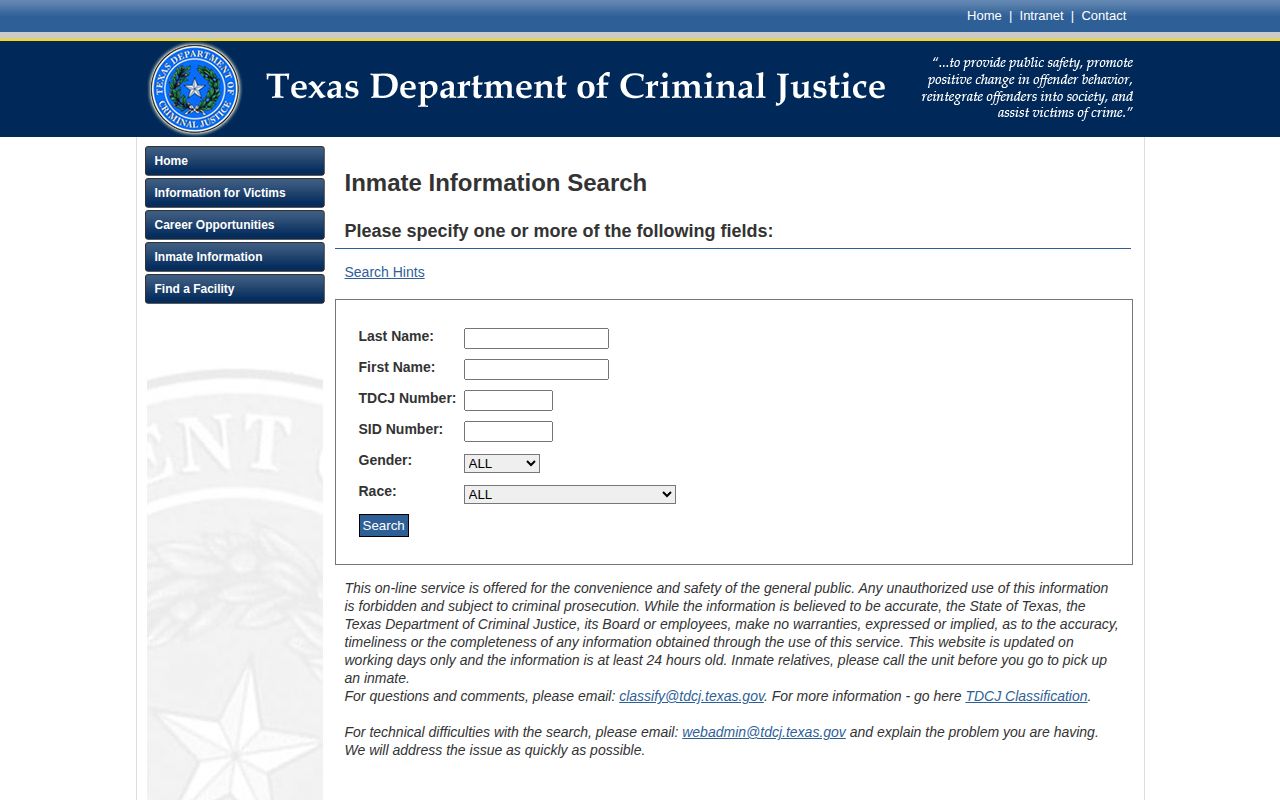
That limit is why a completed TDCJ discharge requires the information or records route rather than a failed online name search.
No Callahan Recent Release Feed
The Kologik interface says “Recent Bookings,” not recent releases. Its Callahan history-mode endpoint returns “N,” and inspected current records had blank release-date values. No official 24-hour or 72-hour public release view, publication schedule, or retention window was found. A missing button is not the only evidence; the tenant setting confirms that historical mode is disabled.
Ask whether the Sheriff already maintains a daily activity report, release log, or jail export for the exact period. The Public Information Act does not require a custom report. If no list exists, request the responsive final release entries and specify useful columns such as booking identifier, actual release time, release type, and receiving agency.
Callahan Post-Release Supervision Records
Parole follows a TDCJ sentence and is administered by the TDCJ Parole Division after a Board decision. Probation, or community supervision, is imposed by a court and should be verified through the sentencing case and the assigned local office. A county bond release is neither one by itself. Discharge means the applicable sentence or supervision term ended, subject to the exact official record.
- Parole
- Conditional community release from TDCJ custody.
- Probation
- Court-ordered community supervision, often without a prison release.
- Discharge
- The recorded end of a sentence or supervision obligation.
- Detainer
- A request or hold that may send a person to another custodian.
Callahan Release Alerts and Transfers
The Sheriff directly links Texas VINELink for local custody status. Search the correct person, compare the reporting agency and identifiers, and register through the matching record when notification is offered. An alert reflects data reported by an agency. It may lag, omit the legal reason, or leave the destination unclear. Confirm it with the Sheriff and court.
A federal path requires a different system. The BOP Inmate Locator covers federal Bureau of Prisons records and can show a release date in its historical range. A U.S. Marshals prisoner may be held in a local contract facility before BOP designation, so the Northern District contact path may be needed. The ICE Online Detainee Locator covers people in ICE custody who meet its search rules. None of these systems proves a Callahan community release unless that agency was the relevant custodian.
TDCJ uses a separate Integrated Victim Services System for state-prison notifications. Do not assume a Callahan VINELink registration follows a person through TDCJ intake. If the Sheriff reports a state transfer, verify the new record in TDCJ and use the state notification process when eligible. A transfer to another county requires a new check with that receiving jail. Each custody system owns its own updates.
Federal pretrial custody can be especially easy to misread. The U.S. Marshals Service may retain responsibility while a person is housed in a contract jail, so a blank BOP result does not settle the question. An ICE locator match indicates immigration custody, not the final immigration case outcome. Ask the Sheriff for the receiving agency recorded on the Callahan transaction before moving to any federal locator.
Match Callahan Custody to Records
Use the source tied to the custody event. A broad search can mix people with the same name or confuse a local transfer with a state discharge.
| Question | Correct source | Main limit |
|---|---|---|
| Still in Callahan jail? | Kologik current roster and Sheriff | No history mode |
| How did Callahan custody end? | Sheriff release transaction | Must be requested |
| What did the court order? | Correct clerk and cause file | Not the physical release timestamp |
| Now in a Texas prison? | TDCJ current Inmate Search | No discharged-person archive |
| Federal custody or release? | BOP or responsible federal agency | Separate from county records |
| ICE custody? | ICE locator and help route | Not proof of immigration outcome |
Callahan County Release Facility
The Callahan County Jail is the only detention facility supported by the reviewed official county material. It is a county pretrial and local custody site operated by the Sheriff's Office, not a TDCJ prison. Arrest entries from city police do not establish separate city jails.
Community releases are confirmed through the Sheriff and court. A TDCJ transfer moves the search to the state system after intake. Another county, BOP, the U.S. Marshals Service, or ICE must be checked through the receiving custodian named in the transfer record. No official source supplied a fixed release hour, public exit, waiting area, property rule, transport plan, weekend policy, or local records-retention schedule.