
Callahan County Projected and Actual Release
TDCJ defines Projected Release Date as its estimated release date based on the type of offense, the sentence, credits, and applicable release mechanisms. Discharge Date is different: it is the date the person completes the sentence and is no longer supervised by TDCJ. Parole eligibility, a favorable Board vote, scheduled processing, maximum expiration, discharge, and physical release are separate milestones.
A Callahan County Jail detainee held before trial has no dependable projected sentence date. Bond may authorize release, but another warrant or detainer can keep custody in place. A court dismissal may end one case without clearing another hold. A name leaving the Kologik roster can also mean transfer.
Find a Callahan County Projected Release Date
First identify the custody system. Running a state formula over a county bond case produces a false answer, while calling the county jail about a later TDCJ sentence reaches the wrong custodian.
- Check the Callahan County current roster only to learn whether the jail presently displays the person. Recent Bookings is not a release-date list.
- Call the Sheriff at 325-854-1444 for a county detainee. Ask whether the record has a jail calculation, court release authority, other hold, or transfer notation.
- Read the court judgment, sentence, jail-credit entry, bond order, or dismissal through the proper County Clerk, District Clerk, or justice court.
- For current TDCJ custody, search by name plus date of birth, TDCJ number, or SID in the TDCJ inmate search. Its public form covers current incarceration, not a released-person archive.
- If the needed TDCJ date is not online, email pia@tdcj.texas.gov with the full name, TDCJ number, and exact request for Projected Release Date or incarceration history.
- After a favorable parole vote, use the post-vote physical-release line. After release, request the actual release or discharge record.
The Callahan County release-record guide covers the Sheriff and court fields used to prove the final event.
Texas Credits in Callahan Release Calculations
Texas Government Code chapter 498 governs TDCJ good-conduct time. Section 498.002 authorizes accrual according to classification under TDCJ rules. Section 498.004 treats good time as a privilege, not a vested right, and permits forfeiture for disciplinary violations within the governing limits.
Good time can affect parole eligibility or mandatory-supervision calculations. It does not shorten the judicial sentence itself and does not guarantee release. Government Code section 508.145 contains offense- and date-sensitive eligibility rules. An ordinary eligible case may reach consideration when calendar time plus good time equals one-fourth of the sentence or 15 years, whichever is less, while designated serious offenses can require calendar-time thresholds under the precise subsection.
Texas has no universal rule requiring every state prisoner to serve 85 percent. That phrase often imports another jurisdiction's rule. The controlling analysis uses the offense date, judgment, sentence structure, jail credit, good-time class, sections 508.145 and 508.149, and Board action. Legacy “3g” shorthand refers to former law now associated with article 42A.054 designated offenses; it cannot replace the current statute.
County-jail calculation is separate. The Sheriff and court apply the actual local sentence, time-served credit, holds, and any applicable credit rule. Kologik does not publish a dependable projected release value for Callahan County.
Why Callahan County Release Dates Change
A date is a calculation against the information then available. Corrected data, a new legal event, or a custody hold can move it. Ask which input changed instead of treating the earlier date as an agency error.
| Factor | Effect on the date |
|---|---|
| Sentence or credit correction | Changes the time calculation when the judgment, start date, or jail credit is corrected. |
| Disciplinary forfeiture | May remove TDCJ good time under chapter 498 and affect eligibility calculations. |
| Consecutive sentence | Can require one sentence milestone to be reached before another controls release. |
| Detainer or warrant | May prevent community release or produce transfer to the holding agency. |
| Board decision | A denial, later approval, or program-conditioned favorable vote changes the path without itself proving release. |
| New court order | Can alter the authority for custody, sentence, bond, or credit. |
| Data processing | Can delay when a current status becomes visible in the public tool. |
Government Code section 508.149 lists mandatory-supervision exclusions and permits discretionary denial for eligible cases under its standards. Eligibility and release remain distinct.
Confirm a Callahan County Release Date
For a local jail event, ask the Sheriff for the actual release date and time, release type or reason, releasing authority, and receiving agency when a transfer occurred. Match those fields to the court cause and order. The current roster cannot prove a past release because its public history mode is disabled.
Register for a named-person event through the Callahan County VINELink check before the expected change. Treat an alert as a prompt to verify. Operational delay, transfer, missed delivery, or identity mismatch can affect notice.
For TDCJ, the pre-vote status line is 512-406-5202 and parole-review results are available at 844-512-0461 with identifiers. A favorable vote may still require a date, program, release plan, or processing. The physical-release status and later record are stronger than the vote alone.
TDCJ Projected Release and Discharge Fields
The official TDCJ definitions page distinguishes Projected Release Date from Discharge Date and other custody terms.
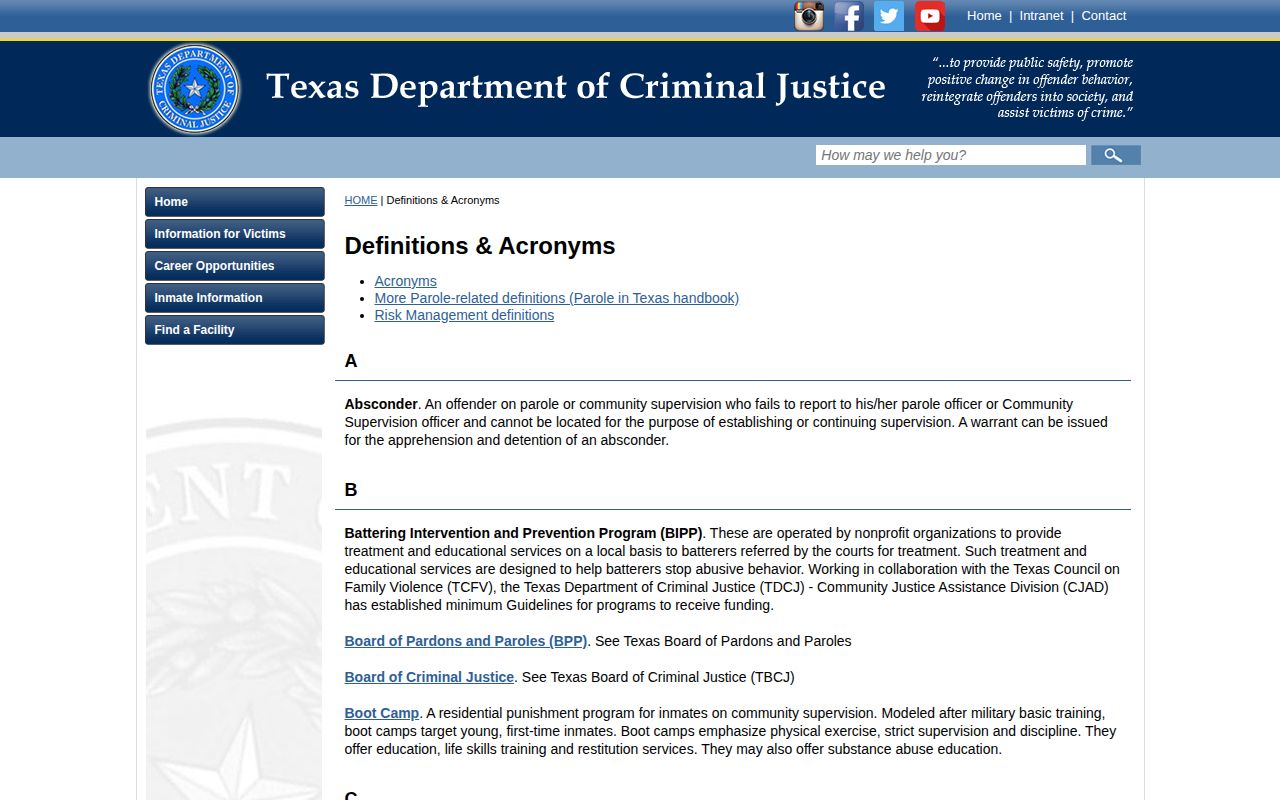
The definitions show why a projected date cannot be copied into a release record as though it were the actual physical event.
- Projected Release Date
- TDCJ's estimate based on sentence data, credits, offense rules, and release mechanism.
- Parole Eligibility Date
- The point when the Board may consider release under applicable law, not a release promise.
- Discharge Date
- The point when the sentence and TDCJ supervision end.
- Actual Release
- The recorded physical departure or transfer event confirmed by the custodial agency.
Callahan Jail Dates Are Not TDCJ Dates
The Callahan County Jail houses local detainees whose release may depend on bond, dismissal, time served, a sentence calculation, warrants, or holds. The Sheriff's record and relevant court file control those facts. The jail vendor schema containing a projected-date key does not mean the public Callahan roster supplies a reliable value.
If a person transfers from Callahan County Jail to TDCJ, county physical custody ends while incarceration continues. Wait for TDCJ intake data, then use state identifiers and channels. If the person moves to another county jail, use that receiving jail. Federal and ICE detention also have separate locators and sentencing rules.
County court records can explain why a date exists or changed. The County Clerk and District Clerk both link LGS Online Records, while justice courts have separate Baird and Clyde locations. Identify the court and cause number before requesting a judgment, bond order, dismissal, sentence, or credit entry. A legal order is strong evidence of authority, but the Sheriff's timestamp still proves when physical custody ended.
Note: Roster disappearance, legal eligibility, a projection, a favorable vote, and actual release are five different events.
Callahan County Dates During Parole Review
Texas does not hold a formal person-by-person hearing for ordinary parole consideration. Parole Division identifies cases about six months before initial eligibility and about four months before a later review date. An institutional parole officer interviews the person and prepares a summary for a three-member panel. Two matching first votes decide the case; otherwise the third member resolves it.
A favorable code is not one single release date. FI-1, FI-2, program-conditioned FI variants, RMS, and consecutive-sentence options can each carry different processing needs. Denial codes include NR, SA, DMS, and combinations. A denial correspondence includes a next-review date, which is another review milestone rather than a projected physical release.
BPP warns that new disciplinary allegations, protest material, or other case information may lead to reconsideration of an earlier vote. After a favorable result, ask the post-vote line about physical-release status and retain the eventual TDCJ release record. The Callahan County parole and probation page distinguishes Board decisions from community supervision.
Request a Callahan County Date Record
When the online tools do not answer the question, request an existing record instead of asking an agency to calculate a new report. For the Sheriff, identify the person and booking and ask for the existing release entry, sentence calculation, or transfer notation. For TDCJ, specify Projected Release Date, incarceration history, discharge data, or parole status so the records office can route the request.
Texas public-information law does not require a governmental body to create information that it does not maintain. Fees depend on the responsive material and applicable cost rules, and the research found no published Callahan Sheriff-specific fee schedule. Ask for electronic copies and a cost estimate. Do not state a retention period because the public roster's disabled history view says nothing about retention of underlying government records.
If two dates conflict, send the agency the exact field, source, and identifier rather than asking a web vendor to correct a government record. Kologik is the Sheriff's display layer. TDCJ owns state calculations, and the filing clerk owns the court entry.
Public Record Search
Sponsored Results