
Callahan County Parole and Probation Compared
Parole and probation can both place a released person under rules in the community, but their legal sources and record custodians differ. The Texas Board of Pardons and Paroles makes parole and mandatory-supervision release decisions. The TDCJ Parole Division supervises people released through those state mechanisms. A Callahan County court imposes probation, formally called community supervision, and the court record identifies the supervision order and cause number.
| Question | Parole | Probation |
|---|---|---|
| Where it begins | After release from TDCJ under a Board decision or mandatory-supervision process | By a court order, sometimes after county jail custody and sometimes without a prison term |
| Decision record | BPP vote, release certificate, and TDCJ parole record | Judgment, order, docket, and local supervision file |
| Who verifies it | TDCJ Parole Division and the assigned district parole office | The sentencing court, clerk, and assigned community-supervision office |
| End of supervision | TDCJ discharge or other formal termination record | Court or supervision record showing completion, discharge, revocation, or modification |
- Parole
- Conditional community release from a TDCJ sentence before the sentence fully expires.
- Probation
- Court-ordered community supervision tied to a criminal case rather than a parole-panel vote.
- Discharge
- A formal end to the sentence or supervision, not merely an absence from a live roster.
- Absconder
- A supervision classification that must be confirmed with the responsible agency; it is not inferred from a missed appointment or stale web result.
Verify Callahan County Post-Release Supervision
Begin with the custody path, not an assumption based on geography. A person released directly from Callahan County Jail may be on bond, have completed a county sentence, be on probation, or have transferred elsewhere. TDCJ parole tools apply only when a TDCJ sentence and state release mechanism are involved.
- Check the official Callahan County jail and court trail. Use the Sheriff's page to reach the current roster, then ask the Sheriff for the actual release or transfer entry if the person is absent.
- Identify the case and court. The County Clerk and District Clerk each link online records, but jurisdiction depends on the cause. Read the judgment or supervision order rather than guessing from a charge label.
- For a TDCJ case, match the full name, TDCJ number or SID, and date of birth. The public TDCJ inmate search is limited to people currently incarcerated, so an absent released person may require the parole information or records route.
- Contact the assigned office and ask whether it supervises the named person. Give identifying details and the cause or TDCJ number. Do not assume that the nearest office owns the case.
- Request the document that answers the question: release certificate, parole status, probation order, revocation order, or final discharge. A verbal status is useful, but the source record is stronger.
For a durable county-jail release record and search path, the Callahan County released-inmates home page explains how the Sheriff, court, and receiving agency fit together.
Callahan County Parole Record Contacts
TDCJ publishes statewide channels for parole information. Its records page directs questions about individuals on parole or mandatory supervision to Parole Division, while separate lines distinguish a pending Board review from physical release after a favorable vote. That division matters because eligibility, a favorable decision, placement under supervision, and final discharge are different events.
8610 Shoal Creek Boulevard
Austin, TX 78757
Parole status and assigned-office verification: use the official Parole Division information channels
Parole review results: 844-512-0461
Post-vote physical release status: 512-406-5202
When calling about a review result, have the full name, TDCJ number and date of birth available. The review-results line and physical-release line answer different questions. Neither substitutes for the Callahan County Sheriff's record when the person left only the county jail.
Callahan County Supervision Violations and Warrants
Conditions can include reporting, residence or travel rules, treatment, program participation, fees, and offense-specific restrictions, but the individual order or release certificate controls. A violation allegation does not by itself show that supervision ended or that the person returned to custody. The supervising authority may investigate, modify conditions, seek a warrant, or begin revocation proceedings.
For parole, verify a warrant or absconder classification with TDCJ Parole Division. TDCJ also maintains a specific sex-offender absconder search, but that specialized tool is not a general list of every person alleged to have violated parole. For probation, use the sentencing court's docket and the local supervision authority. A motion to revoke, warrant entry, arrest, and final revocation order represent separate stages.
Texas VINELink can report an agency-provided custody change for a Callahan County jail record. It does not prove a supervision violation or explain the court action. Confirm the event with the agency that owns it.
How Callahan County Supervision Ends
Supervision ends through a formal record, not because a name disappears from a search. A parole case may reach sentence discharge, an approved termination, revocation, or another status under the applicable Texas law and TDCJ record. A probation case may show successful completion, early discharge, modification, extension, or revocation in the court and supervision file. Ask for the exact status and effective date.
The Texas Government Code chapter 508 governs parole and mandatory supervision, including offense-sensitive eligibility and mandatory-supervision exclusions. Eligibility under section 508.145 means the Board may consider release. It does not guarantee release. Section 508.149 can exclude or permit discretionary denial in specified cases.
Keep the final documents together: the actual physical release entry, release certificate or supervision order, and discharge or completion record. If those records conflict, ask each custodian to explain only the field it owns.
Correcting Callahan County Release Records
Kologik displays the Sheriff-provided jail roster but offers no public correction control. A wrong booking date, release entry, charge display, or booking photo should be raised with the Callahan County Sheriff's Office as the originating custodian. The vendor is the display layer and cannot be treated as the source of the legal record.
A wrong judgment, docket entry, cause number, or probation disposition belongs with the clerk for the court that filed it. This split becomes important after release because a corrected court order may not automatically alter a separate jail display. State parole errors go to TDCJ or BPP according to whether the disputed fact is custody, supervision, or a Board decision.
Texas expunction and nondisclosure rules depend on the order and statute. They should not be described as automatic deletion from every system. Provide the order to each proper custodian and ask how its scope applies to that record.
Does Abilene Handle Callahan County Parole?
The official TDCJ Region V directory lists an Abilene District Parole Office at 5241 West Stamford Street. It is geographically close to Callahan County, but the reviewed directory does not publish a county-assignment table. Proximity alone is not proof that the Abilene office supervises a particular released person.
Confirm the assigned district office through Parole Division using the person's identifiers. Assignment can reflect the approved residence and state case administration, not simply the county where the arrest or jail stay occurred. For probation, confirm the office through the sentencing court instead of calling a parole office.
The official parole-review page shows the state review process before supervision begins.
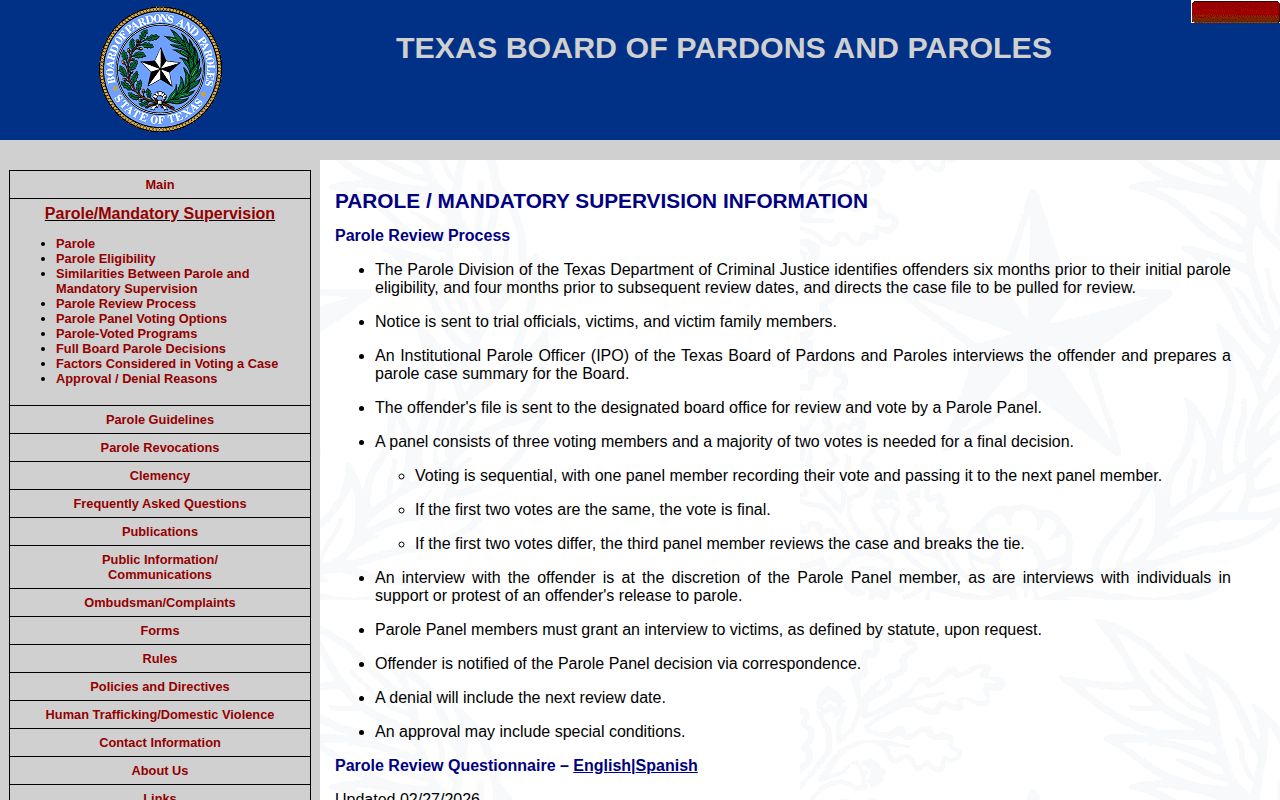
The screen documents a state parole review channel, not a Callahan County probation record or proof of physical release.
Board administrative meeting minutes are also not a calendar for a named person's case. Texas parole panels review files individually rather than holding a courtroom-style public hearing.
Callahan County Parole Review Milestones
Texas does not schedule an ordinary parole case as a formal public hearing for the named person. Parole Division identifies a case about six months before initial eligibility and about four months before a later review date. An institutional parole officer interviews the person and prepares a case summary. A three-member panel votes in sequence; two matching first votes decide, while a split sends the decision to the third member.
A denial correspondence includes a next-review date. Favorable codes include FI-1, FI-2, program-conditioned FI variants, RMS, and options involving consecutive sentences. Denial codes include NR, SA, DMS, and combination codes. Read the full code because a favorable result can still require a program, plan, date, or further processing.
BPP may reconsider a prior vote after new disciplinary allegations, protest information, or other case material. For review results call 844-512-0461 with the name, TDCJ number and date of birth. After a favorable decision, the physical-release line answers whether release processing has actually reached departure. The final TDCJ release record remains the strongest proof.
Public Record Search
Sponsored Results